
Recognising a good cattery
Adopting with confidence
How do you recognise a serious cattery? Here are the simple markers I have kept from my own research, in all honesty.
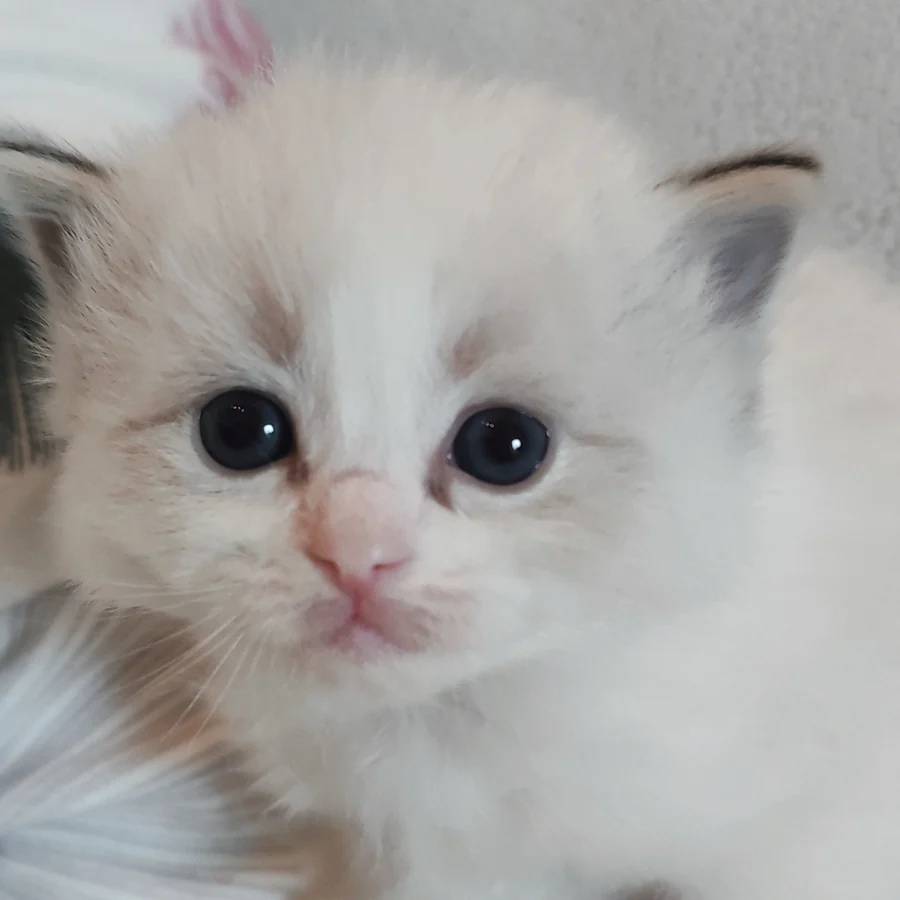
See her profile →
In France, several hundred catteries offer Ragdoll kittens — the LOOF counted 447 with a recently declared litter in its breed statistics ↗, figures dated 2020 but the most recent published to date. In that abundance, it is not always easy to know whom to turn to; a few criteria help you choose with confidence.
Bear in mind, too, that the breed has exploded: the LOOF issued 2,606 Ragdoll pedigrees in 2019 and 4,947 in 2025, making it France’s second most popular breed. A lot of people arrived all at once. A recent cattery is not bad for all that — but experience cannot be improvised.
My aim is not to promote my own cattery, but to share an honest view, based on what I have seen for myself over months of research: hundreds of listings, websites and Facebook pages combed through, and many breeders contacted. No label replaces common sense and conversation — a serious cattery shows itself through several simple signs.
To start your search, the LOOF publishes a directory of catteries with a declared litter ↗. It is a good starting point, but it is not exhaustive: listing there is voluntary, and many perfectly serious catteries do not appear. Absence says nothing bad about a cattery; presence only guarantees that a litter was properly declared to the registry.
- Available to talk — by message, e-mail, phone or in person.
- Sends photos and videos of the kitten and its daily life.
- A fixed price, announced in advance (barring exceptional cases).
- A LOOF pedigree — the only proof of a genuine purebred cat.
- Transparency about vaccinations.
- Health tests on the parents.
- The kitten’s weight shared and tracked.
📋Hobby or professional breeder?
Two statuses coexist under French law, and they are defined by the law, not by the quality of the work:
- Small-scale (“dérogataire”) breeder — at most one litter per year per household, of pedigree-registered animals. On that sole condition, they are exempt from SIREN business registration and from the ACACED certificate. Their listings carry a LOOF litter number instead of a SIREN.
- Professional breeder — from the second litter in a year. SIREN number, declared activity, ACACED, sanitary veterinary follow-up.
The LOOF details these steps on its page How does one become a breeder? ↗ (in French).
It is not a mark of quality, in either direction. A small-scale breeder can work with exemplary rigour; a professional producing many litters, entirely legally, can do anything at all. It remains case by case, and it is the dialogue that will inform you, not the status.
💬How many Ragdoll breeders are there?
Nobody knows precisely. The last count published by the LOOF reports 447 breeders who registered a Ragdoll litter over two years — but it stops at 1 January 2020, and the breed has doubled since. The real number is therefore much higher, and no real-time census exists: catteries open and close all the time.
That is useful to keep in mind when comparing practices: every breeder describes their own, and there is no single norm anyone could claim. The most instructive thing remains to ask the person in front of you to explain their choices and the reasons behind them.
🧬Health tests
Legally, no test is mandatory for breeding. Nothing therefore prevents breeding from a cat whose heart or kidneys have never been checked. But the HCM (heart) and PKD (kidney) tests are the baseline, the elementary minimum: the Ragdoll is a breed concerned by these conditions.
A serious cattery has no difficulty handing over these results, including for a pet kitten. If the request causes discomfort or goes unanswered, that is information in itself. A kitten from untested parents is not necessarily ill — but the absence of tests is no mark of quality, and the risk sometimes surfaces years later.
Better still: an annual echocardiogram of the breeding cats. It is complementary to the genetic test and does not duplicate it — the HCM test looks for one known mutation, while the scan observes the heart as it is, whatever the cause.
The MyCatDNA ↗ test is a plus: more complete and available online, especially the Advanced range. For breeding, the blood group is indispensable.
A point that matters: for these results to be recognised and carried on the pedigree, the tests must be run in a laboratory signed up to the LOOF protocol (GenIndexe, IDEXX, Antagène, MyCatDNA, Laboklin…). The LOOF keeps this list up to date and reminds that results obtained outside the protocol are not taken into account. A good reflex to know: a serious result goes through a referenced lab. See the LOOF’s Health page ↗ (in French)
♡Why we insist so much on documents
Aranel arrived with us as a pet, before the cattery existed. At the time, we did not think to ask for her parents’ HCM/PKD results — and today, those results are not available to us. Perhaps they exist somewhere; we simply cannot consult them, and a file you cannot consult protects no one.
In June 2026, the investigation of a heart murmur led to an echocardiogram. The interventricular septum was measured between 5.5 and 5.9 mm and described as an equivocal thickness, with a follow-up advised twelve months later. No causal link can be established with her ancestry or with the missing parental documents. For us, the lesson lies elsewhere: results are asked for before reserving, while it is still simple to verify the information.

and its signatory laboratories
Our choice
Our breeding cats are checked with MyCatDNA Advanced: the panel is broader than a targeted test and gives, beyond HCM and PKD, data on genetic diversity and colours that we find precious for building our matings. The results are shared without reserve, on simple request.
🏅Breed quality
To judge a Ragdoll’s type and quality, refer to the breed standard, detailed on our page on the Ragdoll standard.
📸Photos, markings and honesty
In a bicolour, the markings matter: the white V must stay symmetrical and not spill beyond the outer edge of the eyes, the bridge of the nose must be white, and the ears must stay coloured. A perfectly symmetrical mask is rare and nobody demands one — but an entirely white ear, an eye entirely caught in the white, or a coloured patch on the nose bridge are departures from the standard, not details.
Hence two points of vigilance about photos:
- Always-identical angles — in particular systematically from below — prevent judging the mask. Ask for a face-on view at eye level, a profile, a top view and a belly view.
- A request for extra photos left unanswered is an answer in itself.
And if a breeder calls a departure from the standard a mere “aesthetic particularity”, they either do not know their standard, or prefer not to talk about it. A kitten with a marking flaw remains a wonderful companion: it simply has to be presented as such, honestly, and its price should reflect it.
🍼The departure age
A kitten leaves at 12 full weeks, after its first vaccine booster, and never before — for its health and for good social weaning. Sometimes you have to wait until 16 weeks. The second booster is not always necessary, depending on the vaccination scheme.
💉Vaccines & parasites
Deworming starts from three weeks of age — a first dose at 3 weeks, a second at 5, a third at 7 —, then every month until six months. A growing kitten is far more sensitive to worms than an adult, and roundworms are passed to it in its mother’s milk: this rhythm is not negotiable. A cattery that announces a first deworming at one month has already skipped the two that matter most.
From six months, the frequency depends on the real risk, that is, outdoor access and the season:
- A cat that goes outside — every 3 months, the four treatments a year ESCCAP holds as the general rhythm.
- A strictly indoor cat — you can stretch it, down to twice a year, to be confirmed with your vet: the cat’s real way of life decides, not a single rule.
Our view
We find it more sensible to vaccinate against feline leukaemia (FeLV) even if the cat does not go out, to prevent any contamination. And on the parasite side, we keep a quarterly rhythm as long as it does not freeze: with the warming climate, frost periods shorten and fleas and ticks stay active most of the year. Better to treat a little more often than to leave a window open.
🥣Food
On the kibble side, our preference goes to Farmina ↗: attractive rates and a very detailed composition — the best we know of. To order it, you need a breeder’s recommendation: contact us, and we will gladly recommend you. If needed, we can also guide you through the different ranges. To go deeper, the FEDIAF nutritional guide ↗ is the reference.
💬What a breeder must be able to tell you
A reservation is often made before the kitten is microchipped. That is normal: the chip is only implanted around two months. But from then on, the breeder must keep you informed, spontaneously.
Concretely, they should be able to hand over without difficulty:
- How the vet visit went — first vaccination, microchipping, weight of the day.
- The identification number as soon as it exists, so you can check that the advertised kitten is indeed the one you will receive.
- Both parents’ pedigrees and their health tests.
- Regular photos and videos throughout the wait.
None of this requires any particular effort from a cattery that works properly: these documents already exist, they just need sending. If the request annoys, drags on, or gets vague answers, that is a signal. It bodes nothing good for the rest of the relationship — and that relationship lasts the cat’s whole life.
To understand what this number is for and from when it exists: our page on cat identification.
🤝The way you are spoken to
It is the least measurable criterion, and probably the most important: you are about to enter a relationship with someone for fifteen years. The day there is a health worry, that is the person you will write to.
What should make you step back:
- Demanding that you be available on the spot. You have the right not to pick up, to answer in writing, to take time to think. Imposing one’s own channel on the other is not communicating.
- Repeated calls after a written message, especially if they turn to irritation or aggressiveness.
- Making you out to be dishonest because you ask a question, hesitate, or change your mind.
- The know-it-all posture: answering beside the point, with condescension or suspicion, rather than sharing information. Whoever masters their subject explains it gladly.
- The inability to talk about their work: what they select for, why this mating, the limits of their own breeding cats. A breeder who sees no flaw in their cats is a breeder who will not evolve.
Breeding is not just producing cute kittens: it is keeping a breed alive according to a standard, with perspective and self-questioning. Breeder status is obtained administratively; everything else shows in the conversation.
⏳Waiting lists
A kitten is not a product you order: it is born, or it is not. When no litter is available, the waiting list simply lets you be told at the next birth. It is a mark of interest, not a commitment: you remain free, and so does the breeder.
Some waiting lists are paid, and that is not abnormal. What the sum buys then is not a kitten: it is access to information — being told about upcoming litters and being able to position yourself on them. The practice is perfectly justified when a cattery receives far more requests than it has kittens: the payment acts as a safeguard, adds a sorting criterion and keeps applications manageable. It is a breeder’s choice, entirely legitimate.
On the other hand, you must know exactly what you are paying and why before taking out your card. Four questions to ask:
- What does the sum give access to? A simple message at birth, or real priority over the kittens?
- Is it deducted from the kitten’s price, or lost if you withdraw?
- Is it refundable if no litter is born, or if no kitten matches your request? These sums are often announced as non-refundable.
- How long will you have to decide when a kitten is offered to you? We see 24-hour windows, which is very short for a fifteen-year commitment.
If those answers are clear, a paid list poses no problem. If they stay vague, it is the vagueness that should stop you — not the principle.
Our view
With us, the waiting list is free and without obligation. Not out of opposition on principle, but because the workload it represents today does not justify billing it: we have no mass of requests to sort. If that were ever to change, we would say so clearly here. See also: deposits, down payments and waiting lists.
🧾Down payment, deposit and guarantees
Every reservation generally comes with a payment — and the two French terms do not mean the same thing. Ask before paying whether it is “arrhes” or an “acompte”, and what happens to the sum if you withdraw.
We detail the difference, together with the only diseases that entitle you to cancel the sale, on our “Price of a Ragdoll” page, deposits section.
⚠Warning signs
Be wary of structures that produce enormous numbers of kittens per year or that stay vague about their practices.
Another clue deserves attention: the way a cattery communicates when a disagreement arises. A serious cattery should be able to explain a difficulty with restraint, distinguish facts from its own appraisal, preserve people’s confidentiality and show that it can learn from experience. Communication that turns into score-settling, or that systematically casts the other party as solely at fault, simply invites caution.
A doubt before taking the plunge? Write to us, we can advise you.
Being able to observe work over time — previous litters, news of kittens who have left, consistency in the answers — is a real marker. But it is one marker among others, not a condition: every cattery started one day, and the absence of history says nothing, in itself, about the quality of the work.
Faced with a recent structure, the criteria simply shift to what is verifiable right away: the transparency of the documents (breeding cats’ health tests, pedigrees, identification), the quality of the dialogue — precise, sourced answers that do not change from one conversation to the next — and the coherence between what is announced and what is shown. A recent cattery that shows everything and answers everything is worth more than an old one that dodges.
We are well placed to say it: this is exactly our situation. Our first litters are expected in 2027, and we have no history to show yet — which is precisely why our documents are published and why this website details our choices, so that you can judge on evidence rather than on seniority.
Frequently asked questions
The questions we are asked most often. Each answer opens with a click.
A small-scale (“dérogataire”) breeder produces at most one litter per year and per tax household, from animals entered in an official pedigree register; on that sole condition they are exempt from SIREN business registration and from the ACACED certificate, and their listings carry a LOOF litter number. From the second litter in a year, the breeder is professional: SIREN number, declared activity, ACACED and veterinary health monitoring. Neither status is a guarantee of quality, in either direction.
No test is legally compulsory for breeding, but HCM (heart) and PKD (kidney) tests are the elementary minimum in the Ragdoll. A serious cattery hands over these results without difficulty, including for a pet kitten. An annual echocardiogram of the breeding cats complements the genetic test. For breeding, the blood group is indispensable.
French law forbids handing over a kitten before 8 weeks. In the Ragdoll, a slow-growing breed that socialises over a long period, leaving at a full 12 weeks after the first vaccine booster is preferable, and sometimes you have to wait until 16 weeks.
Yes, it is a legitimate practice. The sum does not buy a kitten but access to information about forthcoming litters, and it makes most sense when a cattery receives far more enquiries than it has kittens: the payment then acts as a safeguard and helps sort applications. What matters is knowing exactly what you are paying for: what the sum gives access to, whether it is deducted from the kitten’s price, whether it is refundable, and how long you will have to decide. Our own waiting list is free and without commitment.
Deworming starts at three weeks of age, then at 5 and 7 weeks, and is repeated every month until six months. From six months, the frequency depends on the cat’s way of life: every 3 months for a cat that goes outdoors, which matches the four treatments a year held by ESCCAP, and down to twice a year for a strictly indoor cat, to be confirmed with your vet.