Breeding kittens
What the clauses you meet everywhere are really worth, why we set none, and under which conditions an Iris Polaires kitten may leave “entire”.
See his profile →
Expect €2,000 to €3,500 in France, with no real ceiling: a sought-after line, a titled cat or an import trades well above that. What is being paid for here is no longer the kitten — it is access to a genetic heritage, and the right to do something with it.
The phrase “libre de droits” — unrestricted — is everywhere, and it is often used wrongly. In practice, the market splits into three families: genuinely unconditional sales; sales with restrictive clauses — no outside stud service, no selling the offspring for breeding, mandatory testing before any mating, sometimes a kitten given back to the original cattery; and the flat refusal to sell an entire cat at all. These clauses are found in French and foreign catteries alike.
Once the sale is concluded and the price paid, the buyer is the animal’s owner, with the rights that this entails. A clause that later forbids them to breed their own cat is an obligation not to do: enforcing it is very difficult in practice, and the sanction would come down to damages — provided the contract is precise and the harm demonstrable. The LOOF, for its part, has no power to block the registration of a litter on that basis.
In other words: these clauses work above all as moral commitments between breeders. They rest on one’s given word far more than on legal force, and they are rarely brought before a court. Those who use them are perfectly entitled to, and many do so in good faith to protect their work.
French consumer law adds a useful principle: a clause that creates, to the buyer’s detriment, a significant imbalance between the parties’ rights and obligations is unfair, and therefore deemed unwritten (French Consumer Code, art. L 212-1). The rest of the contract continues to apply.
Our position is simple: a clause you do not intend to honour is a clause you do not sign. Better to discuss the framework frankly before the purchase than to discover a disagreement two years later, with a litter on your hands. This is not legal advice: for a contract that binds you, have it reviewed.
We made the opposite choice for our own kittens: no clauses at all. We explain it in detail just below.
It is a deliberate choice, and it deserves an explanation, because it runs against a widespread practice. When we sell an entire kitten, intended for breeding, we attach no restrictive clause whatsoever to the sale: no ban on outside stud services, no ban on selling the offspring for breeding, no approval to seek for matings.
The reason fits in one sentence: selection happens before the sale, not in the contract. If we judge that a kitten is not qualified for breeding, it leaves neutered, as a pet. The problem is solved at the source. And if we sell it entire, it is because we judge it fit — it would then be contradictory to forbid its offspring what we ourselves validated in it.
Why we set no clauses
Because they guarantee nothing. A clause can be neither monitored nor policed. Enforcing it means proving harm before a court — and the harm caused by the breeding of someone’s offspring is, to put it simply, very difficult to establish. We have already come across several cats theoretically under clause whose offspring bred anyway, without any consequence at all.
Because responsibility must stay where it belongs. The kitten we produce carries our affix: we answer for it. Its offspring will carry their breeder’s affix, and that breeder will answer for them in turn. We have neither the time nor the legitimacy to police other people’s work, and we have no intention of trying.
Because we are looking for collaborations, not dependencies. A relationship of subordination between breeders interests us in neither direction. It cuts both ways, in fact: we do not buy breeding cats bound by restrictive clauses ourselves. We run our programme as we see fit, and we let others run theirs.
We do not claim that every mating born of our lines will please us. Some will not please us at all. But forbidding would change nothing: it would simply move the problem into a contract that no one would ever enforce.
What we do ask for, in return
- Compliance with the law — the French commitment-and-knowledge certificate signed, and keeping conditions that meet the animal’s needs. These are our only non-negotiable points, because they do not depend on us.
- A coherent project, presented however you wish — in writing, by phone or face to face. The channel is indifferent to us: a phone call guarantees nothing, and we will judge no one on how they communicate. What matters is that the exchange happens and that the project holds together.
- A deposit and a reservation contract, as for any adoption.
And if a project seems shaky to us, we do not sell. It is as simple as that, and far more effective than any clause: a breeder always has the right to refuse a sale. We would rather say no clearly than sell with strings attached.
That said, let us be honest about what it implies: selling an entire cat means accepting a share of risk. No interview, however long, can detect a liar. We remain available to advise — on feeding, on matings, on anything at all — but advising is not controlling. What amounts to mistreatment is a matter for the law and the veterinary services, not for a contract clause.
One last point, and it is not about money. Nothing legally requires a breeding cat to match the standard, and one can perfectly well breed from an average cat. But selecting means choosing: starting from a cat that does not match the breed’s type condemns you to spend generations correcting what you could simply have chosen not to introduce. Before buying a future breeding cat, our page on the Ragdoll standard details what to look at: skull, profile, bone, markings, coat texture.
Do you breed? Our criteria — and stud services to come
I am open to offers of kittens intended for breeding, exclusively blue or seal bicolour. Here, in detail, is what I am looking for and what I expect in an application.
Type and markings
I am looking for cats that conform to the breed standard. I refer to the five international standards, all freely available: LOOF ↗ · FIFe ↗ · TICA ↗ · CFA ↗ · WCF ↗.
The pedigree: essential, but flexible on the form
A pedigree is essential. Where it comes from, however, is no obstacle at all: a foreign pedigree is worth a French one. I am also glad to work with the LOOF’s annex registers, which are too often misunderstood:
- Main book — the most common case.
- RIEX (experimental registration) — for a purebred cat whose ancestry includes a non-conforming cross; in the Ragdoll, typically a Cherubim ancestor (mink, sepia or solid). It is a fully-fledged LOOF pedigree, and the mention fades out by itself over the generations. I explain the mechanism, generation by generation, on our page about the RIEX mention.
- RIA (registration on appearance) — for a cat whose ancestry is not known over four full generations, recognised within the breed on its phenotype after examination by two qualified LOOF judges. It is also a waiting register: after four controlled generations, the offspring join the main book. Note that two RIA cats cannot be mated together.
The filiation register (RF), on the other hand, does not confer purebred status and cannot be treated as a pedigree: my programme is built on cats registered in the main book, the RIEX or the RIA. A very beautiful cat without a pedigree is still a very beautiful cat — it will simply have its place in a family rather than in a breeding selection.
For the official detail of these registers: RIA / RIEX / RF on the LOOF website ↗ (in French). And to clear any doubt about a cat’s origins, the MyCatDNA Advanced ↗ test checks the C locus, genetic health and line diversity.
The application to send me
- Recent photos from several angles: face, profile, top view and belly view to judge the markings.
- Videos of the cat moving and being handled.
- The parents’ health tests and their weight.
- The pedigree. If it has not been issued yet — frequent for a kitten — I ask at minimum for its identification number, proof that the pedigree has been applied for (mating or birth declaration) and both parents’ pedigrees.
The identification number is a simple number, but it is enough to know where a cat comes from and to trace it back to its breeder. It only exists once the microchip has been implanted, usually around two months of age: I explain all of this on our page about cat identification.
Temperament matters as much as type
I expect a true Ragdoll character: a calm, gentle, confident cat that lets itself be handled without stiffening. The rag doll that gave the breed its name — the LOOF sums the breed’s temperament up in a single word: peaceful. I describe this placid character, and the everyday gestures that reveal it, on our page about the Ragdoll’s signs of affection, and the type criteria on the breed-standard page.
A collaboration built on trust
What I am looking for above all is an unrestricted sale, with no clause governing in advance the cat’s breeding or its offspring. And I return that trust: I stand by the rigour and responsibility of my work, and I will be glad to give regular news of the cat and its offspring to the cattery that entrusted it to me.
Such clauses are common and perfectly legal, and every cattery has its reasons for setting them: I explain in detail what they cover and what they are legally worth higher up this page. If our ways of working meet on this point, let’s write to each other — and symmetrically, our own breeding kittens will be sold without any restrictive clause.
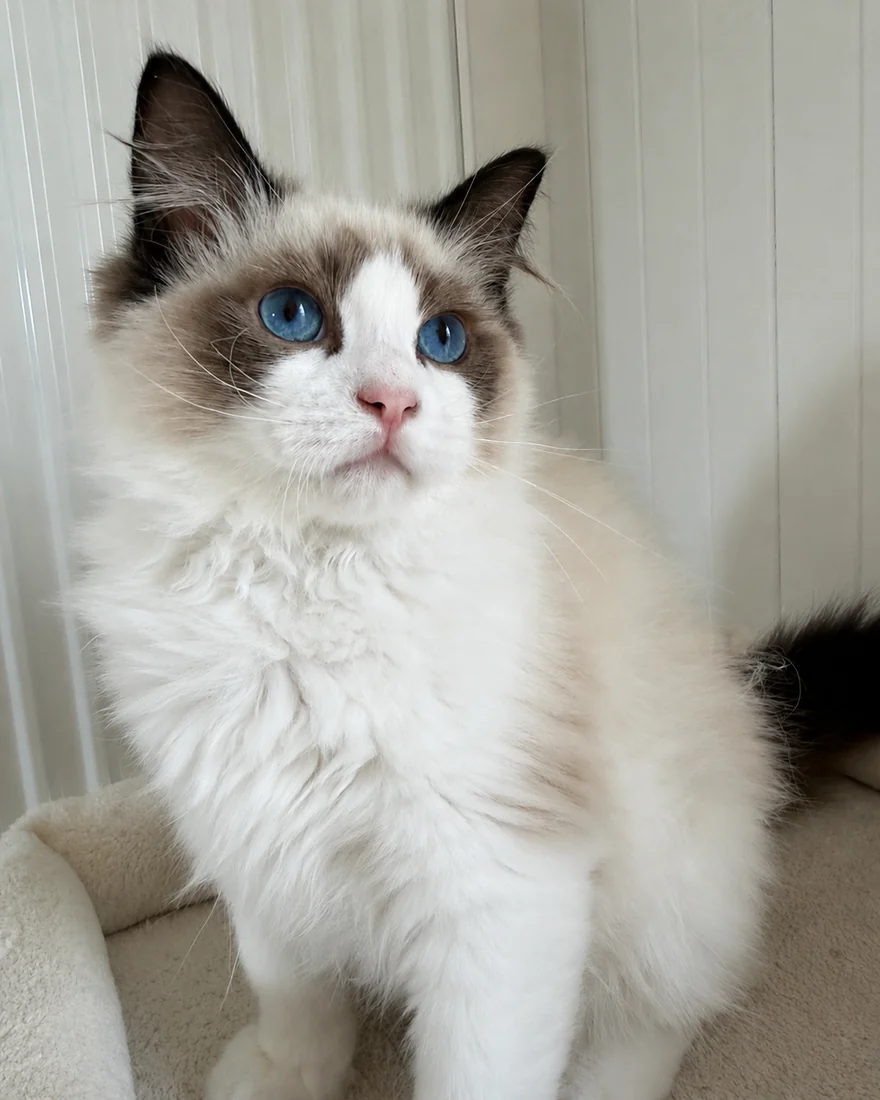
Bijou’s MyCatDNA results came in during September 2026: 49 diseases screened, none found, blood type A/A, no colour recessive — report freely viewable ↗ and detail on his profile. What remains is his first confirmed mating — the guarantee that he is not sterile — before we open his stud services to outside queens.
The health protocol will be non-negotiable: the queen up to date on her vaccinations and under full parasite protection, external and internal (a NexGard Combo-type treatment, which covers fleas, ticks, roundworms and tapeworms in a single application, or an external antiparasitic completed with a broad-spectrum dewormer), with a veterinary health certificate less than five days old.
Matings will take place in a large dedicated room of about 30 m², designed for the comfort and safety of both cats. The fee will be set later, when the service opens.