The coats
Colour, pattern and the distribution of white
A Ragdoll’s coat reads on three levels: its colour, its pattern and its amount of white. The three combine to give the cat’s final appearance.
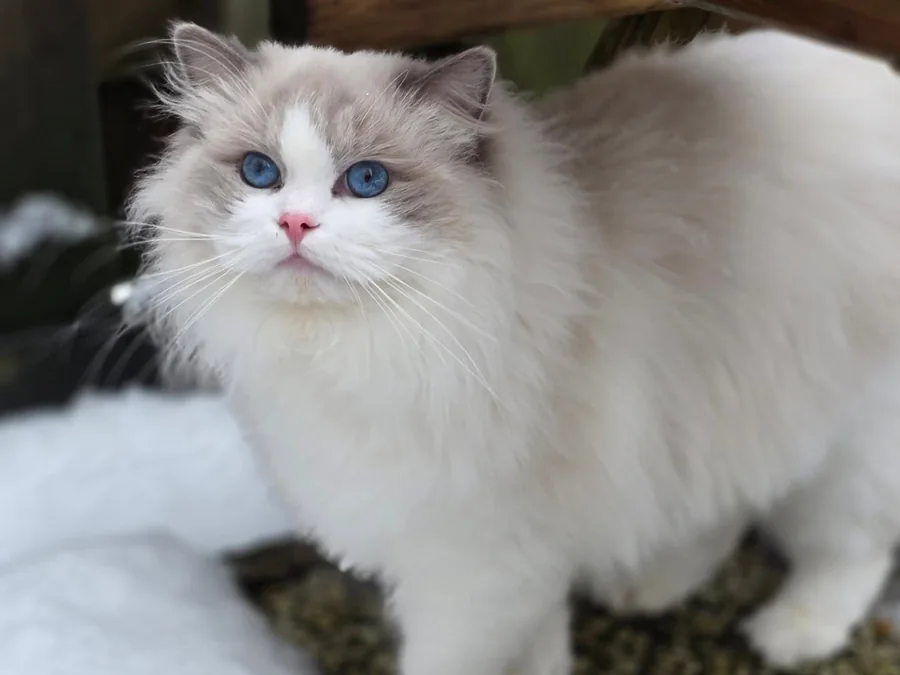
The colour is the shade of the Ragdoll’s markings: the mask, the ears, the legs and the tail. At the cattery, we mainly work with seal and blue, seeking a soft contrast, intensely blue eyes and a harmonious expression.
The Ragdoll comes in eight recognised colours: seal, blue, chocolate, lilac, red, cream, cinnamon and fawn. These colours appear on the extremities, more or less contrasted depending on genetics, body temperature and the cat’s age.
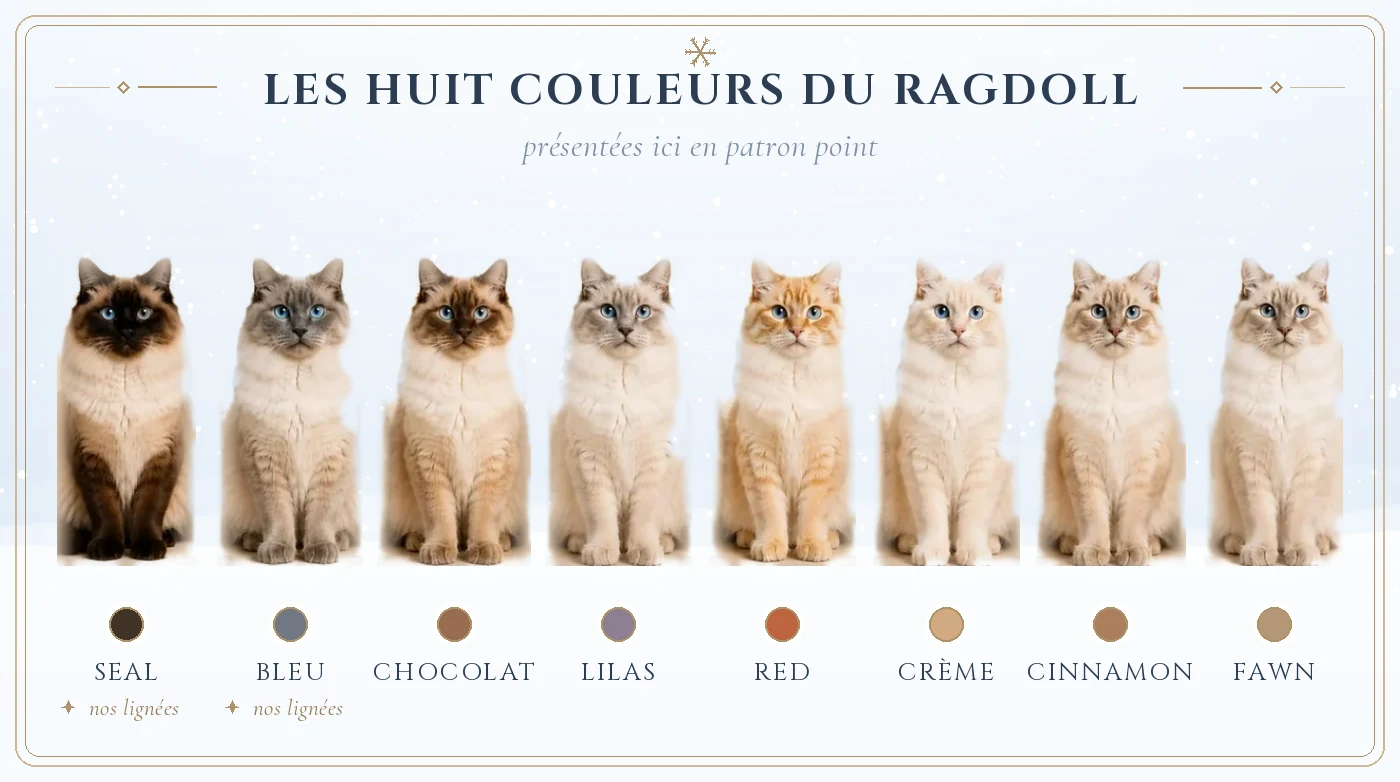
The pattern describes how the colour expresses itself on the body. It is distinct from the amount of white: two cats can share the same colour, yet have very different patterns or white distribution.
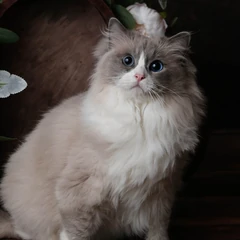
In point, the body stays light and only the extremities — mask, ears, legs and tail — are coloured, with eyes always a frank blue. It is the only Ragdoll pattern in the LOOF’s sense.
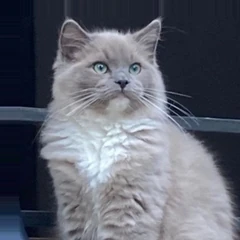
The neighbouring patterns — mink, sepia and solid — let the colour express itself over the whole body, more strongly, and often come with eyes that are not blue: aqua, aquamarine, green or gold. Since 1 January 2026, the LOOF attaches them to the Cherubim, a sister group of the Ragdoll.
Everything hinges on a single gene, the C locus, which governs how the colour is laid down. Its genotype decides both the pattern and the designation, Ragdoll or Cherubim:
To illustrate it, four blue bicolours: same colour, same white distribution. Only the pattern changes from one row to the next.
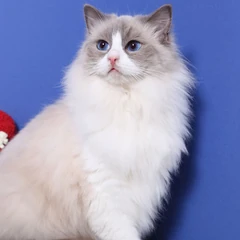 cs/cspoint — coloured extremities, blue eyesRagdoll
 cb/csmink — colour more present, aquamarine eyesCherubim
 cb/cbsepia — strong colour, green / gold eyesCherubim
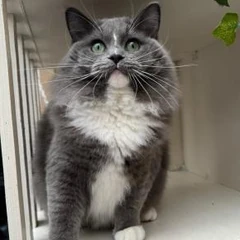 C/C · C/cb · C/cssolid — full colour over the whole bodyCherubim
In plain words: only the homozygous cs/cs gives a Ragdoll. As soon as a C or cb allele steps in, the cat crosses over to the Cherubim side.
A second test comes into play at registration: the HCM-R, the genetic screening for the Ragdoll’s hypertrophic cardiomyopathy (MYBPC3 R820W mutation), the breed’s main hereditary heart disease. The result must be N/N (clear) or N/mutated (healthy carrier) — a carrier can still be registered, but a cat affected on both copies cannot. At the cattery, all our breeding cats are N/N.
A Cherubim parent? Have the kittens tested
If a Cherubim (or a carrier of a C / cb allele) is mated to a pointed Ragdoll, the kittens of one and the same litter can be Ragdoll or Cherubim. Impossible to tell by eye.
To register them, the LOOF then requires the colour test on the C locus (Ragdoll or Cherubim) and the HCM-R on every kitten. Without these tests, no pedigree can be issued — nobody would know which register the kitten belongs to.
On the other hand, if two pointed Ragdolls (cs/cs) are mated but a Cherubim appears in their ancestry, the kittens are indeed Ragdolls: that ancestry is simply flagged by the RIEX mention on the pedigree.
In the Ragdoll, the amount of white runs from colourpoint to van. At the cattery, our lines are selected around the bicolour and the high-mitted, with particular attention to the balance of the markings.
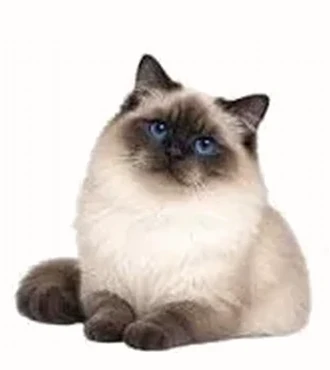
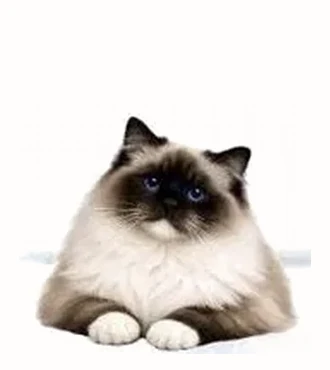
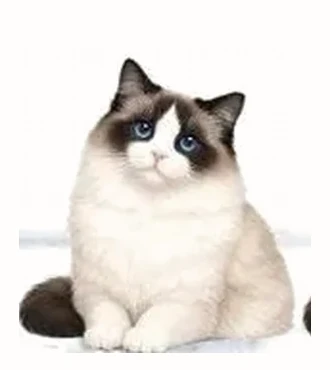
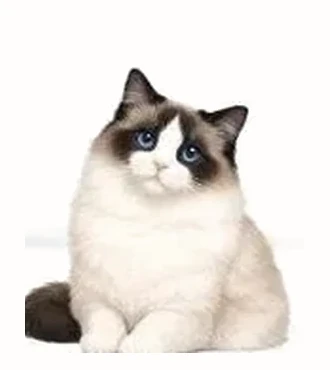
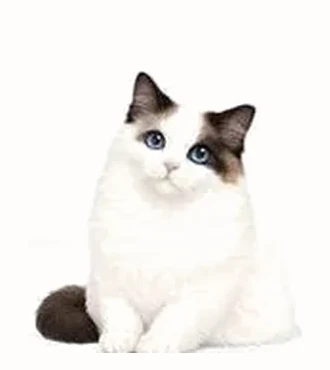
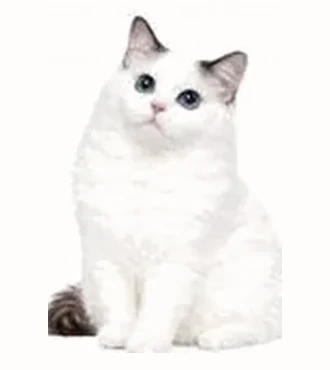
These six steps each carry a pattern name: colourpoint, mitted, high-mitted, bicolour, mid high white and van. All depend on the spotting gene (S), whose expression is highly variable: two cats of the same genotype can carry noticeably different amounts of white. The genotype gives a tendency, never a guarantee.
A breeder’s image to find your bearings: think of a light bulb. Too little white and the pattern looks heavy, too much and the markings scatter — in between lies the balance we seek in the high-mitted bicolour.
A Cherubim ancestor in a pedigree leaves a RIEX mention, which goes out by itself over the generations. We detail this mechanism on a dedicated page.